Sunday, May 22, 2016

Simhastha-Kumbh Mela: Planet's Largest Spiritual Gathering Concludes


Hindus largest congregation on the Earth 'Ujjain Simhastha 2016,' (Kumbha Mela) organized in every 12 years, finally concludes with millions of devotees taking holy dip in the sacred river of Kshipra in ancient and religious city of Ujjain.
In month-long festival, hundreds of thousand believers and spectators coverage from several parts of the world not to just take holy dip (Snan) at the ghats of Kshipra river, but to witness one of the greatest incidents in human history, and the waves spirituality sweeping the Nation.
The Mela is more exclusively known for Naga Sadhus, who after remaining imperceptible from world in deep glaciers of Himalaya for 12 years, gather for royal bath at various akharas at banks of river in hundreds of thousands.
Such a massive gathering at one place is in itself an epitome in the world of management, revealing the mindboggling organizing capacity of India, where population of more than any European country gathers every day, in an unbelievable uncluttered way.

In Hindu mythology taking holy dip at any of the Kumbha Mela once in a lifetime is revered as most sacred event, believed to relinquish people from all worldly sins.

Simhasth Kumbh is one of the four 'Kumbh Melas' celebrated by biggest spiritual gathering on the Planet. Simhasth Kumbh Mela is based on the celestial line-up of Planets and the Signs of the Zodiac, which occurs every 12 years.
'Kumbh' in its literal English translation means 'Pot', which emerged from 'Samudra Manthan'(Churning of the Ocean) between Gods and Devils and the term ‘Mela‘ signifies'Fair'.

Kumbh Mela is held at four places in India i.e Haridwar, Prayag (Allahabad), Ujjain and Nasik. At Haridwar it is held at banks of holy river of Ganges, while it is organized at confluence of Ganges, Yamuna and spiritual (underground) river Sarswati in Allahabad.  In Nasik and Ujjain (Madhya Pradesh) Kumbh is held at sacred river Godawari and Kshipra respectively.


At Ujjain, Kumbh Mela is specifically called 'Simhasth Kumbh Mahaparv' because the Sun (in Sanskrit Surya) is in the zodiac Aries ('Mesh' in Sanskrit) and the Jupiter (Brahaspati in Sanskrit) is in the zodiac Leo (in Sanskrit 'Simha') when it takes place. There are ten unique and uncommon yogs which exist and facilitate the organizing of Simhasth Kumbh Mahaparv.
The periodical event has also socio-cultural significance in Indian (Hindustani) civilization, where since ancient times, Sadhus and Spirituals Gurus assemble for one month in intensive brainstorming cogitating séance for the conscious and emergence of humanity and world. The gathering assembles in every 3 years during Kumbh Mela at one of the places by rotation, for reassessing the amelioration of ideas churned out for welfare of humanity before meeting at Kumbh gathering on12th year.


Monday, May 16, 2016

Israel’s Unexplored Heritage Sites: From History To Tourism


Israel is comprised of the ancient city of Jerusalem and modern city of Tel Aviv, but between these two well-known sites, are less-known heritage sites which hold stories of thousands of years to tell. Spanning from ancient town of Acre in North to Be’er Sheva in southern deserts, the remnants definitely illustrate the narrative of thousands of years of civilizations that nurtured on this land. However, these places have been matter of importance for archaeologists and historians, but now tourists from across the world have been enchanted and enthusiastic to sense the culture and heritage of primeval times. Here are a few of the unexplored heritage sites in the hall of the fame in the land of Israel.


Acre

Among one of the primordial cities in Israel, Acre (Akko) is a Crusader era port town, situated in north of country. The coastal town is a unique melting point of East and West, well-complimented with magnificent structures, testaments to the Crusader and Ottoman periods. Mosques and Christian monasteries alongside underground passages and high-walled alleys makes it mysterious and unique to explore. The remarkable fortified city walls, Turkish baths, halls built by Knights Templar and Crusader buildings are the undeniable examples of historic architectural proficiency.
  
Acre City © wikipedia


Abu Gosh

There is no more quintessential an example of coexistence of humanity than the village of Abu Gosh, on the outskirts of Jerusalem. The Muslim village is home to a Romanesque and Early Gothic-style twelfth century Crusader church, today a Benedictine Monastery, where even Jews, Christians and Muslims sing prayers together in Hebrew. The monastery is run by a group of priests and nuns with shared co-operation with the local Muslim population, which makes the place unique across the region. Notably, the Abu Gosh village, built during Ottoman period, has also become Israel's Hummus capital in recent years.


Abu Gosh Monastery © wikimedia


Be'er Sheva

Apart from walled city from the Israelite monarchic period in Tel Be’er Sheva, a UNESCO heritage site, the desert capital comprises numerous sites of historic importance from Ottoman Period to British mandate. Founded more than more 3700 years ago, when biblical father of Jewish people, Abraham, arrived there, present day Be’er Sheva houses centuries-old structures such as the Governor’s house, now the Negev Museum of Art, and Government House, today a Police Station. The Turkish railway station and hundred-year-old traditional Bedouin market, are among the main attractions, which can easily take visitors back to monarchic cum colonial era.


Hundred year old Turkish Railway Station, Be’er Sheva © wikipedia


 Lohamei Ha’Getaot

This museum helps to get a better sense of the detriment of holocaust survivors who came from Poland and Lithuania decades ago. After leaving behind everything they had, they found refuge at Lohamei Ha’Getaot  (The Ghetto Fighter). Situated between the town of Acre and Nahariya, Lohamei Ha’Getaot abodes Getto Fighters’s House Museum dedicated to those who fought against Nazis during Warsaw Ghetto Uprising, which is first of its kind in World. This Kibbutz naturally reminds visitors the grief and bravery of holocaust survivors who re-established their lives in a small village in Northern Israel at the foothills of Galilee, after escaping from the Nazis. The Kibbutz also encompasses an aqueduct built in 1815 during Ottoman period, one of the engineering masterpieces of its time.


Ghetto Fighters' Museum © wikimedia


Katsrin:

Among lesser known, but imperative heritage sites, is Talmudic-era town Katsrin located in the heart of Golan Heights, surrounded by breath-taking landscapes. The town embraces the archaeological sites of middle Bronze Age, vindicating the 4000 years old Jewish settlements. Amidst the serenity of the Golan, it is easy to imagine the prosperity of ancient civilizations that once inhabited the town, boasting a magnificent sixth century synagogue. The remains of ancient village and reconstructed homes definitely transport visitors to the Talmudic alleyways.

Talmudic-era synagogue, Katsrin © wikimedia

Sunday, April 17, 2016

Tel Aviv, How A Metropolis Transformed Into City of Bunkers


From home, office, park, playground, university to hostel, shopping mall, bar and beaches- there is one thing common that one can find everywhere in the most advanced metropolises of Middle East- Tel Aviv.  'Bunkers', also known as a shelter used during conflicts and wars by soldiers have become a foremost part of everyday life of Israeli people.

There is nice Chinese proverb, "As water shapes itself to the vessel that contains it, a wise man adapts himself to circumstances." This proverb can exactly be applied on Israeli society's approach towards conflict. 

Israeli people have conditioned themselves as they are living in eternal conflict zone. They have made themselves as acquainted to war as they are warrior of ever-going conflict, and that a slightest laxity can cost them Nation.


                                Photo Credit: times of israel

Most Guarded City in the Middle East


I was even astounded to see that how bustling City of Tel Aviv, the commercial capital of Jewish state, has been turned into a landscape of bunkers, security sirens and CCTV cameras, without disturbing its beauty and ethos.

One can never imagine the dreadful sleepless nights people of Israel have spent since last 70 years to save the Nation-State, that Never Sleeps.

Since its very inception in 1948 to till to the date it has been in constant conflict, fighting several direct or indirect wars against neighbouring nations including Palestine, Syria, Lebanon, Jordon and Iraq, and facing terrorism inflicted by them persistently.


Here, nobody knows when a rocket or missile is going to struck in the heart of the City, no one known which second they are going to breath their last. In every 3-4 years there has had been minor or major war. Underground bunkers are the only last resort to protect themselves from heavy bomb strikes from terror groups as soon as security siren alerts them up. 

I met a few people who exclaimed that, they lived for almost a month in underground bunkers of their home during Lebanon war in 2006 to save their lives. The terrorist groups Hezbollah launched rocket attack on major Israeli cities like Haifa, Hadera, Nazareth, Tiberias, Nahariya, Safed, killings hundreds of people.


To save their very existence, to save their one and only Jewish Nation on the planet, they have transformed whole city, even whole Country, into military cantonment, with every corner, every building captivated with bomb proof bunkers, and advanced security system. 

The Country Surrounded by Craziest Enemies


Locals or foreigners, everyone’s foremost duty here is to let people know how to save their lives during emergencies, where the shelters (Bunkers) are, what the security alarms meant for, and what precautions to be followed.  

Although, it’s been my first experience of living amidst conflict zone, I never felt being threatened, interrogated or potential suspect, even Israelis cares as much for foreigners as for their citizens. During recent terrorist attack in Tel Aviv city this January, as soon as the news of attack broke out, I received a precautionary call from my office administration, Tel Aviv University, advising to remain inside home and follow security norms.

From mountains of Golan Heights to Deserts of Negev, from ultra-modern city of Tel Aviv to ancient city of Jerusalem, land of three religions is surrounded by as hostile enemies as no country is the World, equipped with missiles set to attack anytime. 

Persistently bearing brunt of terror, Israel has learned how to save its precious citizens form enemy's strike, and make them fight back to save their mother land.


Terrorist group Hamas in Gaza (South-East) and Hezbollah in Northern front, have left no stone upturned to eliminate the existence of people who wandered all over the World over last two thousand years in the search of refuge. 

Since last one decade, as soon as Israel handed over Gaza Strip to Palestinian Authority in 2005, Hamas terrorist organisation occupied it and started its perpetual missile firing on Israeli territory. Moreover, terror group Hezbollah has incessantly kept firing rockets on major Israeli cities since decades, which forced Israel to transform cities into Cantonment.

Due to having surrounded by craziest people in the world, and only 8 million populations, in Israel, every citizen is compiled to serve in Army no matter what career they pursue. Women are supposed to serve minimum 2 years while the same is 3 years for men.


Many Nations that have taken their very existence for granted must have to learn lessons from Brave-Hearts. Here people's first and foremost Dharma and Karma is Army. Their one and only love is Nation. Where the contest of 'Survival' never seems to end.


Monday, March 28, 2016

Tel Aviv: A Cycle Paradise

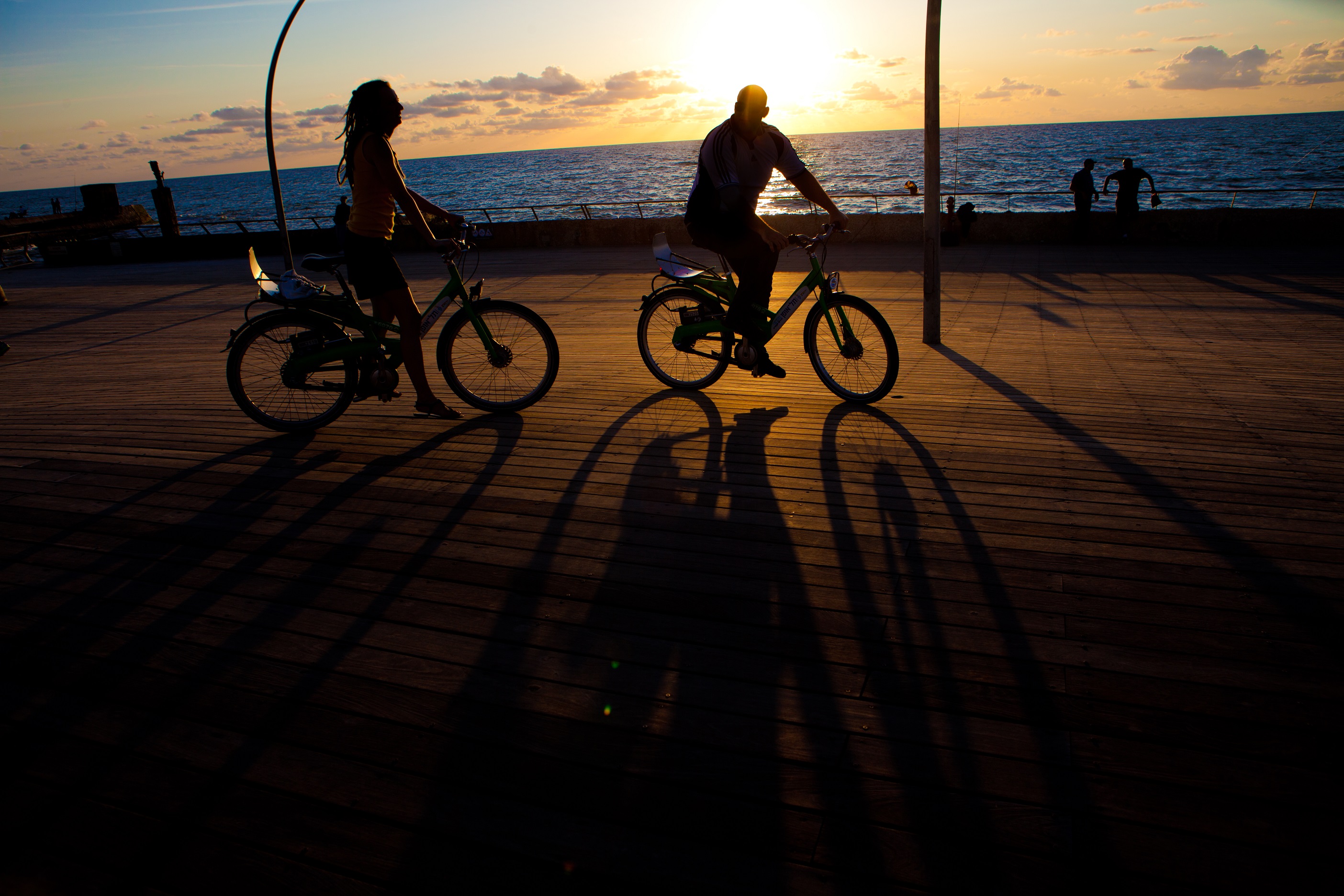
Cycling is hard to resist in Tel Aviv, a haven for bike lovers and the only city in Middle East with an incredible infrastructure for cyclists. Especially in the last few years, cycling has become increasingly popular not only as a form of transport in the city,  but for sports and leisure. There is even a remarkable rental system for bicycles, Tel-o-Fun, which enables people to rent bicycles at any time at hundreds of rental stations around city. This is what makes the White City a cycling paradise. Here are some of the best cycling spots in White City to fully enjoy the activity.


10532313615_8dd5c24da1_o (1)Tel Aviv Port © israelphotogallery/flickr

Tel Aviv Port

Tel Aviv Port it is one of the best tourists spots the in City, with its spacious trail for cycling along the Mediterranean Sea. The place is full of visitors, cafes and fun that make cycling even more enjoyable. It’s not difficult to find one of the Tel-o-Fun Cycle stands at Port, and they only cost a few bucks.

UntitledHayarkon Park © thelastdon/flickr 

Hayarkon Park

Hayarkon Park is the largest park in Tel Aviv, located on the city center’s outskirts. The park has long cycling trails that stretch from Ramat Gan to Tel Aviv’s Port and is one of the biggest cycling spots in the city. Complemented with stunning greenery, a magnificent lake, climbing walls, rowing clubs, water parks, petting zoos and more, it is an ideal destination for a long day of cycling and time spent outdoors.

Untitled1Yarkon River ©  zalul/flickr

Yarkon River 

Besides biking on the beach, there are plenty of other gorgeous options, including cycling by the river. As only river in Tel Aviv, the Yarkon passes from different parks in the vicinity, from Ramat Gan to Tel Aviv Port, and has miles of cycling track on both sides. It is well complemented with beautiful landscape, shady orchards, boating clubs, fun parks, and fields to have some rest and enjoy a  refreshment.

UntitledJaffa Port ©  hemokerem/flickr

Jaffa Port to Tel Aviv Port

Between the fishing harbours of Jaffa Port to Tel Aviv Port is a long 5 km biking path along the beautiful Mediterranean sea, which is, of course, perfect for biking. It’s absolutely thrilling to spend a day biking with friends and picnicking on the seaside, with palm trees, joggers and tourists all around.

15111950458_5de889b360_kGordon Beach © vessokolev/flickr

Gordon Beach

Miles of track flooded with people and recreational activities make Gordon Beach a fantastic place for bike lovers.  It has plenty of space, with wide trails for cycling and a couple of cycle rental stands in the area. The beach is a hotspot for tourists and locals alike, which makes it all the more exciting to take your bike there.

The changing facade of Bollywood

Aamir Khan-Shah Rukh Khan - Kangana0

In past one and a half decade Indian Cinema (Bollywood) has been gone though its transition period. It has absorbed drastic change from its traditional presumption to something out of box.
21st century has changed Indian cinema extensively with movies becoming more subject oriented, critical, satirical, and artistic with common man being portrayed on Silver Screen.
It may started with movies like Lagaan (2001) followed by Swadesh, Chak de India, Tare Zameen Par and went on to even more radical form including Dev D, Gangs of Wasseypur and so on.
This period marked Producers and Directors with increased risk taking capacity to portray the issues which sometimes proved to be financial disaster.
14211971032_0e98f3755c_b0
Image: Flickr
Notably, from 1970s to till 2000 the Indian Hindi Cinema was literally focused on masala movies like family drama, romance, tragedy, action, underworld, crime etc. Superstars like Rajesh Khanna, Amitabh Bachchan, Vinod Khanna, followed by present stars like Aamir Khan, Shahrukh Khan achieved stardom from these movies, which entertained Indian audiences for decades.
The credit may be given to Ashutosh Gowarikar’s Lagaan movie, which after being nominated for Oscar set a trend for already established and new directors to think out of leak.
The trend continued with Swadesh once again by Ashutosh, Rang De Basanti by Rakeyesh Omprakash Mehra, Tare Zameen Par by Aamir Khan, Chak De India, Dev D, Dirty Picture, Fashion, Peepli Live etc.
This trend led another established director Sanjay Leela Bhansali to come up with Black, which gained huge critics worldwide.
R Balki’s Paa was another masterpiece of modern Hindi cinema.
Moreover, Shoojit Sircar’s Vicky Donor, which was a box office success, set a unique instance of movies based on subjects which are bizarre can also be accepted by Indian audience.
Vicky Donor Yami Gautam Ayushmaan Khurrana0
And notably audience has also taken their initiative hand in hand as in new modern times they like movies matched with social reality.
Films such as Life in Metro, Traffic Signal, Peepli Live narrates the story of a common man of India, which was somehow omitted in the movies of 80s and 90s.
In total, it can be presumed that, now, producers are more open to invest in new ideas, and directors are more enthusiastic to work for them.
In due course of time Bollywood directors have fished out themselves from repetitive Masala movies portraying love stories, family dramas, crime and traditional Indian tragedies, which swept Indian audience for decades.
However, it cannot be ruled out that no movies on social issues were made before in the history of Hindi Cinema. From the late 50s to late 60s many such serious subject based films were made. Satyajit Ray’s Pather Panchali, Shyam Benegal’s Ankur, Mehboob Khan’s Mother India, Rikwik Ghatak’s Subarnarekha, Mrinal Sen’s Akash Kusum, etc., were masterpieces of erstwhile Indian cinema. These movies were focused on problems of common man like poverty, prostitution, dowry, and other malpractices prevalent in contemporary Indian society.
But, the trend of Masala movies began in the late 1970s and engulfed the Bollywood towards profit oriented films which gradually started vanishing their pitch, quality, and impact.

Music and Hindi cinema

It will be an injustice if the contribution of music in Indian cinema is not mentioned. Songs have been an integral part of Indian movies which gave them distinct looks as compared to international films. From 50s to 70s industry produced many talented lyricists’ music directors and artist like Pancham Da, Kishor Kumar, Mohammad, Rafi, Majrooh Sultanpouri, Lata Mangeshkar, Shalendra, etc.
But, in the same fashion, unfortunately, it also started fading its charm from late 80s for-ever. Although in recent years, different kinds of music like Sufi, folk, and fusion of Hindustani and western music have been introduced in industry but it could not regain the charm of periods of Lata and Rafi.

Why Indian Film Industry lags behind at international level?

Including Hindi, Tamil, Telugu, Bhojpuri, Punjabi and other regional languages, more than one thousand movies are being produced yearly in India, which is more than whole of Hollywood, Chinese or Korean film industry. Chinese, Korean, Japanese and other country’s film industries produce far lesser movies as India, but their reach is greater than that of India’s.
Indian film industry is now not only laced with big budget, advance technology and superstars, but it is now producing movies out of the box. But, still what is the reason that Indian film industry is unable to draw international audience towards it. Why Indian movies have not international viewership so far?

Although many Indian movies are premiered in many foreign countries, it cannot be ruled out that their audience are only Indians residing abroad. Foreign audience is yet reluctant to spend their pocket money to watch Indian family drama.
Indian movies no matter they are Hindi, Tamil, Telugu or Punjabi are stuck to only Indian audience living abroad while Hollywood movies enjoy massive worldwide viewership. Even, Chinese, Korean and Japanese movies have international viewership, more than India. In India also English and dubbed versions of other foreign movies have greater audience.
Recently years Hollywood movies like Spiderman, Avengers and Jurassic World have even surpassed Indian movies in on their own ground.
What are the underlying reasons behind Indian movies failing to draw international audience should be found out.
Although in past one decade several Indian movies dubbed in English had been released in USA, UK and other countries with high Indian expatriates, but their foreign audience could be counted on fingers.
Kabhi Alvida Na KehnaKal Ho Na HoMy Name is KhanJab Tak Hai Jaan, and several other big budget movies had been released in overseas, but the fact is that they could only draw Indian audience living abroad.
Bollywood experts assert that our Indian audience is too much that we don’t need to resort to international audience. Whether it is home country or overseas, out target audience have always been Indians, and that’s why we are still restricted at a global level.
On the other hand, Indian film director and producers don’t want to compete with foreign movies, because their cinema technology is advanced than that of India, moreover, they perceive fear of financial losses in it, and this may also be as a core reason behind Indian movies not getting Oscar awards.
Nonetheless, in recent years, various Indian movies have been premiered in foreign languages and have been admired at various levels, but it isn’t sufficient for such a huge industry. Now, time has come that Indian film industry should prove its mettle at Global Ground.

Sunday, January 31, 2016

How Cycling could be an essential part of Smart City

Respected Prime Minister, 
Republic of India

As you have given a new life to Radio by starting Man Ki Baat, like this you should also give a new life to Cycle. Cycle is not only the cheapest but a symbolic of sustainable development. 

Almost in all the developed countries cycling has emerged as important mode of transport. I am living in Tel Aviv city Israel. It is one of the smartest Cities in World.  Here children, students, professors, girls, women, adult and even elders use cycling on daily basis for going outside. In Israel cycling has been introduced emerged as a modern mode of transport with hi-tech technology.

Cycling will provide a cheapest transport or vast middle class population of India, but it will also reduce traffic from road and reduce pollution drastically.

In Tel Aiviv, the cycling Stands have been installed in all parts of city, where one can get cycle for rent on hourly or daily charges and can return at any other cycle stand near his/her destination. This is very convenient way as one remains relived from carrying cycle all the way.  This project (Project Name- ‘Tel-O-Fun’) is run by a private company.

This is a fantastic method of transportation. Here cycles are modernised equipped with gears and lights. Here even those who did not like to use cycle in India, are using cycles on daily basis.

We can adopt this project from Israel for sustainable growth of India. It will not only save money, fuel and reduce pollution, but also be beneficial for people’s health.


In the last few years, cycling has become increasingly popular not only as a form of transport in the city,  but for sports and leisure. There is even a remarkable rental system for bicycles, Tel-o-Fun, which enables people to rent bicycles at any time at hundreds of rental stations around city.


Here I have mentioned a link to the website of the cycling project (Tel-0-Fun) running in Tel Aviv City, Israel along with a video showing how cycling works here.


Link-


Sanjay Shukla
Tel Aviv, Israel

Email: Sanjay.acdc268@gmail.com


How to Earn From Artificial Intelligence?

Artificial Intelligence (AI) has become one of the most transformative technologies of the 21st century, revolutionizing industries and re...