Monday, March 28, 2016

Tel Aviv: A Cycle Paradise

Cycling is hard to resist in Tel Aviv, a haven for bike lovers and the only city in Middle East with an incredible infrastructure for cyclists. Especially in the last few years, cycling has become increasingly popular not only as a form of transport in the city,  but for sports and leisure. There is even a remarkable rental system for bicycles, Tel-o-Fun, which enables people to rent bicycles at any time at hundreds of rental stations around city. This is what makes the White City a cycling paradise. Here are some of the best cycling spots in White City to fully enjoy the activity.


10532313615_8dd5c24da1_o (1)Tel Aviv Port © israelphotogallery/flickr

Tel Aviv Port

Tel Aviv Port it is one of the best tourists spots the in City, with its spacious trail for cycling along the Mediterranean Sea. The place is full of visitors, cafes and fun that make cycling even more enjoyable. It’s not difficult to find one of the Tel-o-Fun Cycle stands at Port, and they only cost a few bucks.

UntitledHayarkon Park © thelastdon/flickr 

Hayarkon Park

Hayarkon Park is the largest park in Tel Aviv, located on the city center’s outskirts. The park has long cycling trails that stretch from Ramat Gan to Tel Aviv’s Port and is one of the biggest cycling spots in the city. Complemented with stunning greenery, a magnificent lake, climbing walls, rowing clubs, water parks, petting zoos and more, it is an ideal destination for a long day of cycling and time spent outdoors.

Untitled1Yarkon River ©  zalul/flickr

Yarkon River 

Besides biking on the beach, there are plenty of other gorgeous options, including cycling by the river. As only river in Tel Aviv, the Yarkon passes from different parks in the vicinity, from Ramat Gan to Tel Aviv Port, and has miles of cycling track on both sides. It is well complemented with beautiful landscape, shady orchards, boating clubs, fun parks, and fields to have some rest and enjoy a  refreshment.

UntitledJaffa Port ©  hemokerem/flickr

Jaffa Port to Tel Aviv Port

Between the fishing harbours of Jaffa Port to Tel Aviv Port is a long 5 km biking path along the beautiful Mediterranean sea, which is, of course, perfect for biking. It’s absolutely thrilling to spend a day biking with friends and picnicking on the seaside, with palm trees, joggers and tourists all around.

15111950458_5de889b360_kGordon Beach © vessokolev/flickr

Gordon Beach

Miles of track flooded with people and recreational activities make Gordon Beach a fantastic place for bike lovers.  It has plenty of space, with wide trails for cycling and a couple of cycle rental stands in the area. The beach is a hotspot for tourists and locals alike, which makes it all the more exciting to take your bike there.

The changing facade of Bollywood

Aamir Khan-Shah Rukh Khan - Kangana0

In past one and a half decade Indian Cinema (Bollywood) has been gone though its transition period. It has absorbed drastic change from its traditional presumption to something out of box.
21st century has changed Indian cinema extensively with movies becoming more subject oriented, critical, satirical, and artistic with common man being portrayed on Silver Screen.
It may started with movies like Lagaan (2001) followed by Swadesh, Chak de India, Tare Zameen Par and went on to even more radical form including Dev D, Gangs of Wasseypur and so on.
This period marked Producers and Directors with increased risk taking capacity to portray the issues which sometimes proved to be financial disaster.
14211971032_0e98f3755c_b0
Image: Flickr
Notably, from 1970s to till 2000 the Indian Hindi Cinema was literally focused on masala movies like family drama, romance, tragedy, action, underworld, crime etc. Superstars like Rajesh Khanna, Amitabh Bachchan, Vinod Khanna, followed by present stars like Aamir Khan, Shahrukh Khan achieved stardom from these movies, which entertained Indian audiences for decades.
The credit may be given to Ashutosh Gowarikar’s Lagaan movie, which after being nominated for Oscar set a trend for already established and new directors to think out of leak.
The trend continued with Swadesh once again by Ashutosh, Rang De Basanti by Rakeyesh Omprakash Mehra, Tare Zameen Par by Aamir Khan, Chak De India, Dev D, Dirty Picture, Fashion, Peepli Live etc.
This trend led another established director Sanjay Leela Bhansali to come up with Black, which gained huge critics worldwide.
R Balki’s Paa was another masterpiece of modern Hindi cinema.
Moreover, Shoojit Sircar’s Vicky Donor, which was a box office success, set a unique instance of movies based on subjects which are bizarre can also be accepted by Indian audience.
Vicky Donor Yami Gautam Ayushmaan Khurrana0
And notably audience has also taken their initiative hand in hand as in new modern times they like movies matched with social reality.
Films such as Life in Metro, Traffic Signal, Peepli Live narrates the story of a common man of India, which was somehow omitted in the movies of 80s and 90s.
In total, it can be presumed that, now, producers are more open to invest in new ideas, and directors are more enthusiastic to work for them.
In due course of time Bollywood directors have fished out themselves from repetitive Masala movies portraying love stories, family dramas, crime and traditional Indian tragedies, which swept Indian audience for decades.
However, it cannot be ruled out that no movies on social issues were made before in the history of Hindi Cinema. From the late 50s to late 60s many such serious subject based films were made. Satyajit Ray’s Pather Panchali, Shyam Benegal’s Ankur, Mehboob Khan’s Mother India, Rikwik Ghatak’s Subarnarekha, Mrinal Sen’s Akash Kusum, etc., were masterpieces of erstwhile Indian cinema. These movies were focused on problems of common man like poverty, prostitution, dowry, and other malpractices prevalent in contemporary Indian society.
But, the trend of Masala movies began in the late 1970s and engulfed the Bollywood towards profit oriented films which gradually started vanishing their pitch, quality, and impact.

Music and Hindi cinema

It will be an injustice if the contribution of music in Indian cinema is not mentioned. Songs have been an integral part of Indian movies which gave them distinct looks as compared to international films. From 50s to 70s industry produced many talented lyricists’ music directors and artist like Pancham Da, Kishor Kumar, Mohammad, Rafi, Majrooh Sultanpouri, Lata Mangeshkar, Shalendra, etc.
But, in the same fashion, unfortunately, it also started fading its charm from late 80s for-ever. Although in recent years, different kinds of music like Sufi, folk, and fusion of Hindustani and western music have been introduced in industry but it could not regain the charm of periods of Lata and Rafi.

Why Indian Film Industry lags behind at international level?

Including Hindi, Tamil, Telugu, Bhojpuri, Punjabi and other regional languages, more than one thousand movies are being produced yearly in India, which is more than whole of Hollywood, Chinese or Korean film industry. Chinese, Korean, Japanese and other country’s film industries produce far lesser movies as India, but their reach is greater than that of India’s.
Indian film industry is now not only laced with big budget, advance technology and superstars, but it is now producing movies out of the box. But, still what is the reason that Indian film industry is unable to draw international audience towards it. Why Indian movies have not international viewership so far?

Although many Indian movies are premiered in many foreign countries, it cannot be ruled out that their audience are only Indians residing abroad. Foreign audience is yet reluctant to spend their pocket money to watch Indian family drama.
Indian movies no matter they are Hindi, Tamil, Telugu or Punjabi are stuck to only Indian audience living abroad while Hollywood movies enjoy massive worldwide viewership. Even, Chinese, Korean and Japanese movies have international viewership, more than India. In India also English and dubbed versions of other foreign movies have greater audience.
Recently years Hollywood movies like Spiderman, Avengers and Jurassic World have even surpassed Indian movies in on their own ground.
What are the underlying reasons behind Indian movies failing to draw international audience should be found out.
Although in past one decade several Indian movies dubbed in English had been released in USA, UK and other countries with high Indian expatriates, but their foreign audience could be counted on fingers.
Kabhi Alvida Na KehnaKal Ho Na HoMy Name is KhanJab Tak Hai Jaan, and several other big budget movies had been released in overseas, but the fact is that they could only draw Indian audience living abroad.
Bollywood experts assert that our Indian audience is too much that we don’t need to resort to international audience. Whether it is home country or overseas, out target audience have always been Indians, and that’s why we are still restricted at a global level.
On the other hand, Indian film director and producers don’t want to compete with foreign movies, because their cinema technology is advanced than that of India, moreover, they perceive fear of financial losses in it, and this may also be as a core reason behind Indian movies not getting Oscar awards.
Nonetheless, in recent years, various Indian movies have been premiered in foreign languages and have been admired at various levels, but it isn’t sufficient for such a huge industry. Now, time has come that Indian film industry should prove its mettle at Global Ground.

Sunday, January 31, 2016

How Cycling could be an essential part of Smart City

Respected Prime Minister, 
Republic of India

As you have given a new life to Radio by starting Man Ki Baat, like this you should also give a new life to Cycle. Cycle is not only the cheapest but a symbolic of sustainable development. 

Almost in all the developed countries cycling has emerged as important mode of transport. I am living in Tel Aviv city Israel. It is one of the smartest Cities in World.  Here children, students, professors, girls, women, adult and even elders use cycling on daily basis for going outside. In Israel cycling has been introduced emerged as a modern mode of transport with hi-tech technology.

Cycling will provide a cheapest transport or vast middle class population of India, but it will also reduce traffic from road and reduce pollution drastically.

In Tel Aiviv, the cycling Stands have been installed in all parts of city, where one can get cycle for rent on hourly or daily charges and can return at any other cycle stand near his/her destination. This is very convenient way as one remains relived from carrying cycle all the way.  This project (Project Name- ‘Tel-O-Fun’) is run by a private company.

This is a fantastic method of transportation. Here cycles are modernised equipped with gears and lights. Here even those who did not like to use cycle in India, are using cycles on daily basis.

We can adopt this project from Israel for sustainable growth of India. It will not only save money, fuel and reduce pollution, but also be beneficial for people’s health.


In the last few years, cycling has become increasingly popular not only as a form of transport in the city,  but for sports and leisure. There is even a remarkable rental system for bicycles, Tel-o-Fun, which enables people to rent bicycles at any time at hundreds of rental stations around city.


Here I have mentioned a link to the website of the cycling project (Tel-0-Fun) running in Tel Aviv City, Israel along with a video showing how cycling works here.


Link-


Sanjay Shukla
Tel Aviv, Israel

Email: Sanjay.acdc268@gmail.com


Monday, January 18, 2016

Paradigm Shift in Indian Polity

 
Anna, AAP and 2014 elections have transformed the Indian polity forever. 2011 Anna Anti-Corruption Movement, 2012's overnight rise of Aam Admi party (Common Man's Party) led by Arvind Kejriwal and Modi's solo elections 2014  have triggered a paradigm shift in the Indian politics as never before.
Well-coupled with social media, the rise of Anna Hazare, Aam Admi Party and Modi led Bharatiya Janata Party in past 4 years have threaten deeply all the erstwhile oligarchs of Indian politics.  Specifically, revolutionary rise of these two parties in 2013 and 2014 polarized the Indian politics drastically.


                                                           © elections.in


Such was the effect that some the political dynasties like Congress, SP, BSP, JDU, LJP were shaken out completely from waves of these parties, while CPI, CPM, were rooted out from their very roots in 2014 elections. Other regional parties also faced set back in different regional.

Amalgam of all these factors aired a new kind of political environment in India as never before. Almost all the political parties have appeared directly or indirectly as opposition to ruling party, in the vengeance of defeat.

Anyhow, this has given rise to profoundly strong but fragmented opposition against on party.

However, it cannot be ruled out that each and every political party have had their vote banks whether it is on sectarian or caste based. And almost all the political parties no matter national or regional Sectarianism and Casteism as their trump card for election. If Congress, CPI, CPM lured Muslim voted then, SP, BSP, JDU and LJP had casteism bank policy. But collectively all these parties have been pro-Muslim voters since their inception. 

On the other hand, BJP which has an image of Hindu nationalist cannot even won support of Hindu voters in India, due to its radical approach in previous elections.

However, a lot of research and wiring have been done on what I mentioned above. What naïve that I noticed in recent years is that, after being feared to protect their existence, all of these parties discovered another new and trivial kind of politics.

Political debates are necessary for sustaining the democratic values, but in such a trivial way was never a feature of Indian polity. 

The situation have become so worse, that even a single move of ruling party (BJP) or PM make their ears erect to exploit  it for political gains.

And amidst the war of rat and cats media plays a role of broker grabbing whatever both sides thrown on their mouth.  Moreover, advent of social media has given another tool for such political blame game.

As a common man, I am not taking side of any political party, but it is extensively true that such cheap political have never been part of India.

Common man is somewhat getting frustrated from such cheap polity of such intellectuals who are elected to shape their fate. These parties are creating communal hatred among people, which lives happily with each other.

These politicians must first consider themselves as Indian no matter what religion and beliefs they share, and stop dividing the people of India.  First British divided us on the basis on religion, cast and north and south and ruled and now these politicians have inherited those traits.

No country has copyright of any religion and their followers.  Not Saudi Arabia has copyright of Islam, India have Hinduism and Israel has Jews. All is first – 'Humanity'.


Sunday, December 6, 2015

Like Diwali, Jews Celebrate 'Hanukkah'

                     "Hanukkah is Jewish Festival of Lights, as Diwali for Indians" 
Lighting up houses with bright candles, chanting songs of victory and peace, distributing sweets and gifts and wishing each other well-being and prosperity, this is how Hannukah is celebrated, also known as the Festival of Lights. Surprisingly, this festival significantly resembles the iconic Hindu Diwali.


Untitled3
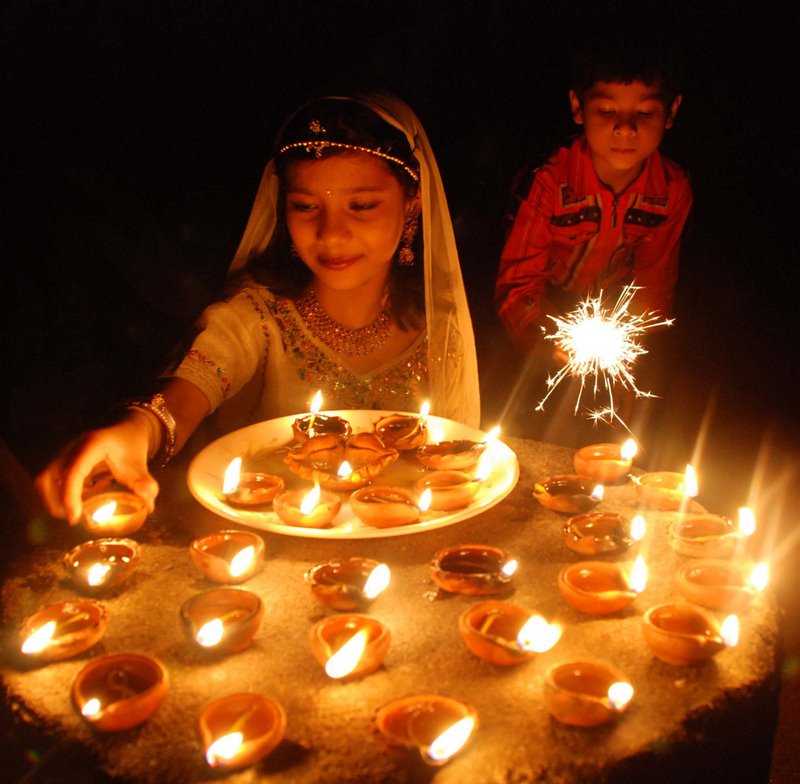
Candles and Diyas symbolic of Festival of Light | © abhinabahtt and chosenpeople.com

Diwali Festival

Diwali is another festival of lights observed for five days in India by Hindus. There are many similarities between the two. The Jewish festival of lights, Hanukkah, is celebrated for eight consecutive nights sometime between late November and late December – determined by the Hebrew calendar – in Israel and by Jewish people all over the world. Hanukkah could be called the ‘Jewish Diwali,’ celebrated to commemorate the victory of good over evil since ancient times.
Diwali Celebration | © Pradip Mahato/Flickr
In India, the festival of lights, Diwali, usually falls in October and November – determined by the Hindu calendar – and is celebrated by the lighting of Diyas(lamps/candles) in and around the house and windows, wearing new clothes, preparing special dishes and sweets, opening festive crackers, and giving or receiving surprise gifts from relatives and friends.
In the same way, Hanukkah is celebrated with lightning of candles on the menorah(a candelabrum with nine branches) followed by the chanting of songs and the distribution of presents.
Hanukkah Lights
Hanukkah Lights | © Djampa/Wiki Commons 
Both festivals owe ancient importance, in their respective religion, to instances of war and victory, of good over evil. As per Hindu mythology, Diwali is celebrated in the name of Lord Rama (Hindu God) of Ayodhya, after his victory over the evil Ravana, when the people of Ayodhya lit lamps to celebrate his return and illuminated the whole city.
Diwali is observed for five days substituted by other small festivals including DhanterasChhoti Diwali (Small Diwali), Diwali, Gowardhan Pooja and Bhai Duj.
Hannukah Traditions
The story of Hannukah is the remembrance of the Jewish victory of over the Syrian-Greek Army and reclaiming of the Jewish Holy Temple in Jerusalem over 2,100 years ago. You can visit the sites from the story still today.
DCMinyan_Hanukkah
Hanukkah Celebration © Rebecca Israel/WikiCommons
The story is that the army struck the Holy Temple in Jerusalem, leaving them with only enough oil to light one day, but that it stayed lit for eight consecutive days and nights, once they had won the war. This is why the Jewish people light the menorah using a single candle (the shamash), and commemorate Hanukkah to the mark the miracle that the oil lasted, by lighting candles from right to left each day from one to eight. They also eat deep-fried traditional dishes to symbolize this.

Diwali and Hanukkah, celebrated throughout the world, are the reflection of victory of light over darkness, knowledge over ignorance, good over evil, and hope over despair.

Saturday, November 28, 2015

‘Country of Conflicts’


      24 hours, 365 days, struggle continues between life and death, for the existence, bombs and rockets are every second on the target, here the difference of life and death is merely 15 seconds, they have to escape, and they have to be alive so that they can save their Country. Here the 15 seconds stands for siren warning against air attacks alerting people to hide under bunkers to save their lives.

Every day, there is a new fight for their survival, the word like war, terror, bomb, rocket and missile has now been inherited in the soul of citizens.It’s the story of the Country, which has been in conflicts since its inception in 15th May 1948, which has been fighting for its very existence on Map, where war in is the nerves of its citizens, The State of ‘Israel’- The land of Three Faiths-The Bone of Contention.

In last 70 years the Jewish country has been in direct fight with all its Arab neighbors, who consider Israel as their motherland.

In Israel the young generation prior becoming engineer, doctor, scientist, think of Nation, think of Army the foremost to all. Youths, Students, regardless of their gender and status, go to School and College or Work, only after ensuring safeguard of their nation. What will be use of Education when there will be no Nation to live, this what they have in their souls.

Army is their religion, Army is their culture, and Army is their deed. This is the country where from Prime Minister to Peasant, Richest to Poorest, Laborer to Leader and Capitalist to Communist, everyone is first supposed to serve Nation.

Israel has different connotation of terrorism and its supporters, and has very strong urge to save its citizens.

Israeli cities appears much more like cantonments where each and every corner is captivated with bomb proof bunkers whether it is home, office, ground, university, market, shopping mall, to save precious lives of its citizens, as no one knows when a rockets is going to destroy Jerusalem or Tel Aviv. Palestine and Gaza is round the clock preparing to launch missiles, rocket here.

The State of Israel, on June 5, 1967, was going to be disappeared from Earth, after being invaded by Egypt, Syria and Jordan armies via three sides. It was the situation of Do or Die for Israel who did not leave any stone unturned for the sake of their land, losing more than 1 percent of its citizens in famous Six-day War.


It must be charisma that Israeli Air Force got lead against trio-army, defeating and scooting them from their own land with Israel capturing Gaza Strip, West Bank and Sinai Peninsula up to Suez Canal in Egypt, more than three times of its size.

It is certainly a matter of amaze that how Israelis are accustomed to such kind of life.

Even after being in fight with neighboring countries from 70 years, spending a big chunk of GDP for continuous renovation of military, how it stood up as most advanced country, certainly tells its story of struggle. The Tel Aviv city is among the most modern, beautiful, smart and safe cities in the world. 

How to Earn From Artificial Intelligence?

Artificial Intelligence (AI) has become one of the most transformative technologies of the 21st century, revolutionizing industries and re...