Sunday, February 24, 2019

#MeToo movement: Will anything change in reality?

No time in the Nation’s history witnessed the situation when women, in such a large number, gathered the courage to take on their perpetrators, by naming them publicly, which is in itself an unprecedented event towards paving a way to ensure better women’s safety and security for generations to come.

The recent few weeks have been instrumental in making a long-lasting impression in Indian patriarchal society, where girls/women are ashamed of coming forward to report sexual assault with themselves.


With #MeToo movement sweeping the nation; women from different walks of lives challenged the status quo, where victims are suppressed to stay mum, by naming the names of sexual predators on social media.

Although gradually, but #MeToo movement gathered momentum in India, and people from different fraternities come forward in the support of victims.

India’s #MeToo movement gathered impetus when model-turned actress Tanushree Dutta, during a TV interview, accused veteran Bollywood actor Nana Patekar of sexual harassment at the sets of film, Horn ok Please, in 2008.

After United States and China, it took a bit to take off in India, but gradually the movement has taken the nation by storm, as it was followed by hundreds of women from film, media, corporate and  other fraternities, exposing their harassers on Twitter and Facebook, as India media is giving special coverage to the movement in prime time show.

In what could be a metamorphic happening in India’s modern history, the women gathered courage to report their sexual harassment at work place by taking the names of people who walked away with it as nothing happened, and who also holds influential positions in their respective fields.

After Dutta, including actress Sona Mohapatra, Kangana Ranaut, Kate Sharma, film producer Vinta Nanda, journalists- Priya Ramani, Shuma Raha, Kanika Gahlaut,Suparna Sharma, Ghazala Wahab, Saba Naqvi, Kadambari Wade, Ruth David, Malini Bhupta, Janice Sequeira and Ira Trivedi- many women expressed their #MeToo moments in last few weeks over social media.
The movement took the country by shock as people from film celebrities like Nana Patekar, Annu Malik, Sajid Khan, Utsav Chakraborty, Vikas Bahl, Alok Nath, singer Abhijeet, director Subhash Ghai to notable author Chatan Bhagat, Suhel Seth and Rajya Sabha Member and former Minister of State for External Affairs M J Akbar have been accused of sexual harassment of their female colleagues at work place on social media.

Following the sexual harassment and rape allegations, Cine and TV Artistes’ Association (CINTTA) expelled actor Alok Nath from the organization, while owing to mounting pressure of #MeToo movement on central government, MJ Akbar, accused by 16 female journalists, who held various influential positions at Asian Age, The Telegraph and India Today, had to resign from the post.
Even corporate world didn’t remain untouched from waves of movement, as women in corporate sector also opened up to report their #MeToo moments, leading them to revisit their policy to ensure safety and security of female employees at work place.
Also, taking serious note on the issue, Maneka Gandhi, Minister of Women and Child Welfare appointed a high-level committee of judges to look into each and every case reported case under the #MeToo movement.

Given the recent developments revolving around women’s safety across the country, the actual storm of #MeToomovement began brewing inside victims of such incidents since December 2012 after brutal gang-rape of a Nirbhaya, which led to a nationwide outrage followed by government taking numbers of measures to ensure more safety for women.

However, the harsh reality is that like #Nirbhaya movement, #MeToo too remains stuck only to big cities, as women’s voice is still clamped down by male dominant society, when it comes to sexual assault in small cities, moffussil towns and villages. They still cannot gather courage to speak up as patriarchal society takes toll on them to keep them shut across the hinterland.
Following national-wide outrage after Nirbhaya rape tragedy, there were abrupt increase in number of cases reported pertaining to women assault/rape, however, as the movement lost its spate, situation returned to what it was before December 2012.

Being one of the most conservative societies, coupled with regional and language differences, and limited access to technology, the India’s #MeToo’s still strives to stretch its reach from urban elites to women in semi-urban and rural areas, where more than half of the country’s women live in vulnerable conditions.


Saturday, February 10, 2018

Padman: Shattering the Social Stigma Towards Menstruation !

Never before in the history of modern India, hardcore feminists, reformers, activists, intellectuals and media, for that matter, who claim to be well-wisher and pillars of democracy ever talked so blatantly about such a the deep-rooted problem of society.

The entire country came to standstill after Nirbhaya tragedy, but rapes continued to rise. Feminists took to the streets protesting for the rights of women for wearing clothes of their choice, roam freely, have the right to choose their profession, life partner etc. But did they ever think that more than 50% of women in India are still stigmatized for being the creator of Life?

There has been a lack of genuine efforts by feminists, activists, intellectuals and Media to bring positive change in the lives of adolescent girls and women, who have been the victim of social taboo, in small cities, towns and villages.

In India where women’s health is still not linked with menstruation, where the topic of menstruation has traditionally been ostracized and kept away from discussions in the public domain and even within the households, the stigmatization continues to risk the health of adolescent girls and women.

This is apart from affecting their day-to-day functioning and participation in public life. The use of sanitary products by adolescent girls and women in India is still decided by access, affordability and social attitude towards menstruation.

 A journey from Social Expulsion to the United Nations

The journey of Padman from making ordinary Pads with cotton and velvet to protect his wife from diseases due to using dirty cloths, to becoming laughingstock for everyone for talking about Pads openly, the protagonist faced social expulsion for taking the issue publicly. Embarrassed from his desperation to make sanitary pads, his wife, mother and sisters abandoned him. Still, the protagonist went on to set up a makeshift machine for manufacturing Pads by borrowing money.

Nonetheless, it was Sonam Kapor who helped him to showcase his invention at National Level Innovations Summit at IIT Delhi to change the lives of women in rural India by providing them with low cost sanitary pads. And the movie ends with his speech at United Nations Women Summit about Pads as he emerged as a social reformer.

The film was based on the real story of Arunachalam Muruganantham, who is the inventor of the low-cost sanitary pad making machine and is credited for innovating grassroots mechanisms for generating awareness about traditional unhygienic practices around menstruation in rural India.

 Shot at the banks of Narmada, the film has beautifully showcased the mesmerizing beauty of the epic city of Maheshwar, and Mandu in Madhya Pradesh.

Akshay Kumar, Radhika Apte and Sonam Kapoor have undeniably done extraordinary work to sensitize the masses about how important women’s menstrual health is.

Who would have thought that such issue, which people run away from talking about, would be one day showcased on the silver screen by a film star?  Padman has definitely done something exceptional by raising this issue on the big screen. Thanks to efforts of R Balki, that now politicians, intellectuals, feminists and Media are openly talking about this to make women their vote bank and TRP.

The Indian film industry and the audience have shown some sense of maturity with embracing the issues wholeheartedly.  No other film super start did dare to make movies on issues like open defecation, menstruation etc., fearing their stardom.

Monday, July 3, 2017

Indian Jews: The Forgotten Diaspora


Which country will not boast of its pervasive Diaspora around the world? Strong bonds with Diaspora always strengthen a nation’s ability to exert diplomatic pressure over rest of the world, just as Israel did it beautifully, by getting hold of Jewish votes in United States.
Yes, there is only one nation on the Earth which denies its allegiance with people of its own origin- India.
 India hasn't been as reluctant in recognizing Hindus, Christians, Muslims, Sikhs, Jain, and Buddhists of Indian origin living all across the world, as it has been for acknowledging more than 80 thousand Indian Jews living in Israel since decades.


India not only denied establishing diplomatic relations with Jewish state, but cut off allegiance with thousands of Indian Jews, who migrated there during 1950s-60s, after Israel opened its citizenship (Aliyah) to all Jews around the world.

Millions of Jews migrated from Europe, North and South America, Ethiopia, Iran, Iraq and India to land of three religions as it opened its border for them wholeheartedly after independence in 1948.

Most of Indian Jews lived in Cochin and Mumbai for more than thousand years since there exodus began 2000 years ago first by Christian crusaders, then Islam.

Wherever they fled for asylum around the globe, curse of anti-Semitism didn't stop them following for millennia, and the place where Jews found actual solace, where they never faced a single instant of anti-Semitism till to date is none other than India.

Major groups of Indian Jews, which comes under category of Sephadi Jews, include Cochin Jews, Bene Israel, Jews of Goa and Baghdadi Jews.


Cochin Jews (Spanish, Portuguese, Paradesi and British Jews) settled in Kerala as merchants and traders, whereas Chennai Jews arrived at Madras during 16th century following their expulsion from Liberia.
Jews of Goa include Portuguese Jews who fled to Portuguese Goa after the commencement of the Inquisition in Portugal.
The Jews arrived from Iraq, Iran and Afghanistan around 250 years ago settled in Surat, were called Baghdadi Jews.
Meanwhile, Bene Israel lived in Karachi, Sindh and Punjab region of undivided India. Many of them moved to Mumbai following partition, while others to Israel after 1948.


After 1948, Indian Jews, settled in different parts of Israel, flourished and assimilate with migrants of other nationalities. Most of them settled in Katamon in Jerusalem, Beersheba, Ramla, Dimona, and Yeruham.

Indian food, language, art, and culture, despite of huge cultural amalgamation, did find recognition in the land of migrants.

It has been India's too much infatuation for Arab countries and Indian Muslims, that no Indian administration, politician or social group ever tried to connect or communicate with Jews with Indian blood.


Indian National Congress, known as hardcore pro-Arab/Muslim Party, deliberately didn't extend any relations with Jewish country to safeguard their innate vote bank, whereas some efforts had been initiated by Hindu Nationalist Bhartiya Janata Party between 1998 and 2003 under Atal Bihari Vajpayee government. 

Hindu nationalist group Rashtriya Swayamsevak Sangh, tried to further its affection for Israel and Jews since Israel’s Independence, but could not make it as political agenda, due its insignificance in Indian scenario.

Present government of Bhartiya Janata Party, backed by Hindu nationalist group Rashtriya Swayamsevak Sangh as its ideological backbone, again in a mood to romance Hindu-Jewish unity, as they there common enemy.

With Modi's visit to Jewish state (First by an Indian Prime Minister) on 4th and 5th July, Indian Jews in Israel and India hopes for reviving their historic connection with their country of origin.

On 5th July, Modi is going to address more than 10,000 Indian Jews in Tel Aviv, to trigger a spark a new Indo-Israel and Hindu-Jews relations.


Sunday, June 18, 2017

Modi’s Israel Visit a New Era of Hindu-Jewish Unity

Why does a tiny besieged Nation, Israel, raises heartbeats of Indian Statesmen? Why are India-Israel aggressively romanticizing relationships, when India is overtly pro-Arab and Israel a hardcore anti-Muslim state?

The roots of India's anti-Israel stand goes 7 decades back when India and Israel got their independence in 1947 and 1948 respectively.


Just after independence from British, out of anti-British-American disposition, because of centuries of servitude, Jawaharlal Nehru, first prime minister of India moulded India into Pro-Muslim-Communist-Soviet state, while Israel became American surrogate in Middle East.

After decades of isolation from Israel under Nehru-Gandhi regime due to pro-Arab policy, Impotent India socialist government, after the collapse of USSR in late 1980s, keeled down to United States, and the route they chose was none other than - Israel.

When USSR failed to aid India against economic and military crisis during 1991-92, India felt obliged to bow down to US via appeasing Jewish state.

In-spite of dramatic shift in India’s foreign policy, as a Pakistan's closest ally, US, seemed reluctant to help India economically and militarily in early 1990s financial crisis, leaving India with only one time-tested option for advanced and affordable military technology- Israel.

Amid all odds, Indo-Israel ties began to gain some momentum during Hindu nationalist Bharatiya Janata Party government led by Atal Bihari Vajpayee (1998-2004), with then Indian foreign minister Jaswant Singh (2000) visiting Israel followed by first visit of an Israeli Prime Minister Ariel Sharon in 2003.

However, all the advancements in bilateral relations made by BJP government were reversed with the return of UPA-1 (Left-Liberals) between 2004 and 2014. Nonetheless, imports of weapons and covert exchange of intelligence information continued.  

The string of bilateral visits has been resumed with the comeback of BJP government since May 2014, and has once again paved a way for rise of two pre-historic civilisations.
In last 3 years of Modi government, Indian home minister Rajnath Singh, President Pranab Mukherjee and foreign minister Sushma Swaraj have had been to Israel, while Israeli President Reuven Rivlin, defence Minister Moshe Ya’alon visited India.


As we celebrate silver jubilee of Indo-Israel ties, let’s hope Narendra Modi’s 3-day visit (first by an Indian Prime Minister) to Israel starting from July 4 would take the Hindu-Jewish unity to greater heights to lead the world.


Wednesday, June 1, 2016

2 Years of Modi: 'Branding India as a Global Master'

Rise of Modi or India
Keeping aside all statistical affirmative indicators of India's growth, in last 2 years, the present government has unquestionably been successful in framing Nation’s image as an emerging lumbering Elephant in South-East Asia.
Not to mention the accomplishments and actions may differ from promise, nevertheless New Delhi, so far, drew worldwide attention as an unfolding economic power. 

It can undeniably be a unique coincidence of emergence of BJP government, which completes 2 year in power on 25th of May, 2016, and surge of global crisis.
000_Del6377111-e1419003097975© Times of Israel
Rise of ISIS, China's de-accelerated economy, Western stagnancy and fall of global oil prices, complimented the incumbents, who came with full majority for the first time Indian electoral history (Only party after Congress), to stage an optimistic image of Country at international stage.

Besides emergence of new era of terrorism, fall of regime after regime in Middle East and refugee/migrants crises in Middle East, North Africa and Europe have been focal point of global discourse.

Meanwhile, India kept itself occupied in scaling the length and breadth of economic world.
Mapping the East and West

Less than 2 years of his tenure he scaled world form Magnolia in Far East to far Seychelles off East Africa, where no Indian premier ever paid attention. He led India emerge as a mediator power between western and eastern power.
Modi, not only took lead in aligning the far eastern countries like Magnolia, Seychelles, Indian oceans island countries Mauritius, Fiji, and Central Asian countries etc, which although do not have significance on world map, but do play keyhole in shaping India's aspiration of permanent member of UNSC.

After new premier swept to power in 2013, China embarked itself in eradicating deep rooted corruption in bureaucracy, intensifying cracked down on public and media outrage, while, Obama administration could not heed beyond sanctioning Russia’s re-conquest of Eastern Europe,  and unbalancing Arabian peninsula by tabling the nuclear agreement.

On one hand, Putin invested most his energy in reviving SOVIET legacy, US has been successful in inundating former SOVIET stronghold Cuba, most of the world discourse remained between migrant and UK's realignment from EU.
On the other hand, sensing the vacuum in global dias, Modi slated himself as a joining link between East and West, emerging as a leader with influential and decisive power.
Balancing the Middle-East

Since mid 2014, as Saudi's oil dominance has been on downhill, and Iran's nuclear deal imbibed another kind of contention in Arabian Peninsula. At the same, time, Modi, not only successfully balanced China and USA, but Shia and Sunni along with Jewish State, with recent his visits to Saudi Arabia and Iran, and foreign minister’s Israel visit.

Even he has been successful in mapping the largest landlocked part of world, central Asia, and with Chabahar port agreement with Iran, Modi assured India's opening in Central Asia, which has been neglected from global arena after fall of SOVIET, even having a big chunk of natural resources there.

Last 2 years has seen far intensive foreign policy under Modi administration which India never seen before.

And, amid the entire furore Modi is going to address joint session of US Congress, the world’s most power full legislative body, which decided the discourse of world for decades.

However, even after making felt India's presence from Far East to West, Modi administration has been failed in countering not only Pakistan, but Nepal which is considered to be India’s little brother for centuries.


Although India has presence in African nations, but still very less aligned with Latin American nations, where still Indian needs to search grounds.

Sunday, May 22, 2016

Simhastha-Kumbh Mela: Planet's Largest Spiritual Gathering Concludes


Hindus largest congregation on the Earth 'Ujjain Simhastha 2016,' (Kumbha Mela) organized in every 12 years, finally concludes with millions of devotees taking holy dip in the sacred river of Kshipra in ancient and religious city of Ujjain.
In month-long festival, hundreds of thousand believers and spectators coverage from several parts of the world not to just take holy dip (Snan) at the ghats of Kshipra river, but to witness one of the greatest incidents in human history, and the waves spirituality sweeping the Nation.
The Mela is more exclusively known for Naga Sadhus, who after remaining imperceptible from world in deep glaciers of Himalaya for 12 years, gather for royal bath at various akharas at banks of river in hundreds of thousands.
Such a massive gathering at one place is in itself an epitome in the world of management, revealing the mindboggling organizing capacity of India, where population of more than any European country gathers every day, in an unbelievable uncluttered way.

In Hindu mythology taking holy dip at any of the Kumbha Mela once in a lifetime is revered as most sacred event, believed to relinquish people from all worldly sins.

Simhasth Kumbh is one of the four 'Kumbh Melas' celebrated by biggest spiritual gathering on the Planet. Simhasth Kumbh Mela is based on the celestial line-up of Planets and the Signs of the Zodiac, which occurs every 12 years.
'Kumbh' in its literal English translation means 'Pot', which emerged from 'Samudra Manthan'(Churning of the Ocean) between Gods and Devils and the term ‘Mela‘ signifies'Fair'.

Kumbh Mela is held at four places in India i.e Haridwar, Prayag (Allahabad), Ujjain and Nasik. At Haridwar it is held at banks of holy river of Ganges, while it is organized at confluence of Ganges, Yamuna and spiritual (underground) river Sarswati in Allahabad.  In Nasik and Ujjain (Madhya Pradesh) Kumbh is held at sacred river Godawari and Kshipra respectively.


At Ujjain, Kumbh Mela is specifically called 'Simhasth Kumbh Mahaparv' because the Sun (in Sanskrit Surya) is in the zodiac Aries ('Mesh' in Sanskrit) and the Jupiter (Brahaspati in Sanskrit) is in the zodiac Leo (in Sanskrit 'Simha') when it takes place. There are ten unique and uncommon yogs which exist and facilitate the organizing of Simhasth Kumbh Mahaparv.
The periodical event has also socio-cultural significance in Indian (Hindustani) civilization, where since ancient times, Sadhus and Spirituals Gurus assemble for one month in intensive brainstorming cogitating séance for the conscious and emergence of humanity and world. The gathering assembles in every 3 years during Kumbh Mela at one of the places by rotation, for reassessing the amelioration of ideas churned out for welfare of humanity before meeting at Kumbh gathering on12th year.


Monday, May 16, 2016

Israel’s Unexplored Heritage Sites: From History To Tourism


Israel is comprised of the ancient city of Jerusalem and modern city of Tel Aviv, but between these two well-known sites, are less-known heritage sites which hold stories of thousands of years to tell. Spanning from ancient town of Acre in North to Be’er Sheva in southern deserts, the remnants definitely illustrate the narrative of thousands of years of civilizations that nurtured on this land. However, these places have been matter of importance for archaeologists and historians, but now tourists from across the world have been enchanted and enthusiastic to sense the culture and heritage of primeval times. Here are a few of the unexplored heritage sites in the hall of the fame in the land of Israel.


Acre

Among one of the primordial cities in Israel, Acre (Akko) is a Crusader era port town, situated in north of country. The coastal town is a unique melting point of East and West, well-complimented with magnificent structures, testaments to the Crusader and Ottoman periods. Mosques and Christian monasteries alongside underground passages and high-walled alleys makes it mysterious and unique to explore. The remarkable fortified city walls, Turkish baths, halls built by Knights Templar and Crusader buildings are the undeniable examples of historic architectural proficiency.
  
Acre City © wikipedia


Abu Gosh

There is no more quintessential an example of coexistence of humanity than the village of Abu Gosh, on the outskirts of Jerusalem. The Muslim village is home to a Romanesque and Early Gothic-style twelfth century Crusader church, today a Benedictine Monastery, where even Jews, Christians and Muslims sing prayers together in Hebrew. The monastery is run by a group of priests and nuns with shared co-operation with the local Muslim population, which makes the place unique across the region. Notably, the Abu Gosh village, built during Ottoman period, has also become Israel's Hummus capital in recent years.


Abu Gosh Monastery © wikimedia


Be'er Sheva

Apart from walled city from the Israelite monarchic period in Tel Be’er Sheva, a UNESCO heritage site, the desert capital comprises numerous sites of historic importance from Ottoman Period to British mandate. Founded more than more 3700 years ago, when biblical father of Jewish people, Abraham, arrived there, present day Be’er Sheva houses centuries-old structures such as the Governor’s house, now the Negev Museum of Art, and Government House, today a Police Station. The Turkish railway station and hundred-year-old traditional Bedouin market, are among the main attractions, which can easily take visitors back to monarchic cum colonial era.


Hundred year old Turkish Railway Station, Be’er Sheva © wikipedia


 Lohamei Ha’Getaot

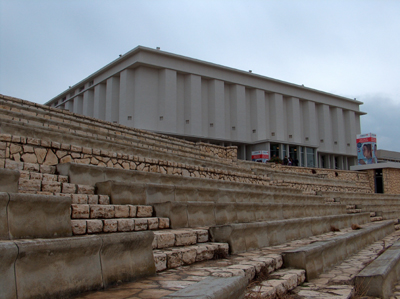
This museum helps to get a better sense of the detriment of holocaust survivors who came from Poland and Lithuania decades ago. After leaving behind everything they had, they found refuge at Lohamei Ha’Getaot  (The Ghetto Fighter). Situated between the town of Acre and Nahariya, Lohamei Ha’Getaot abodes Getto Fighters’s House Museum dedicated to those who fought against Nazis during Warsaw Ghetto Uprising, which is first of its kind in World. This Kibbutz naturally reminds visitors the grief and bravery of holocaust survivors who re-established their lives in a small village in Northern Israel at the foothills of Galilee, after escaping from the Nazis. The Kibbutz also encompasses an aqueduct built in 1815 during Ottoman period, one of the engineering masterpieces of its time.


Ghetto Fighters' Museum © wikimedia


Katsrin:

Among lesser known, but imperative heritage sites, is Talmudic-era town Katsrin located in the heart of Golan Heights, surrounded by breath-taking landscapes. The town embraces the archaeological sites of middle Bronze Age, vindicating the 4000 years old Jewish settlements. Amidst the serenity of the Golan, it is easy to imagine the prosperity of ancient civilizations that once inhabited the town, boasting a magnificent sixth century synagogue. The remains of ancient village and reconstructed homes definitely transport visitors to the Talmudic alleyways.

Talmudic-era synagogue, Katsrin © wikimedia

How to Earn From Artificial Intelligence?

Artificial Intelligence (AI) has become one of the most transformative technologies of the 21st century, revolutionizing industries and re...